
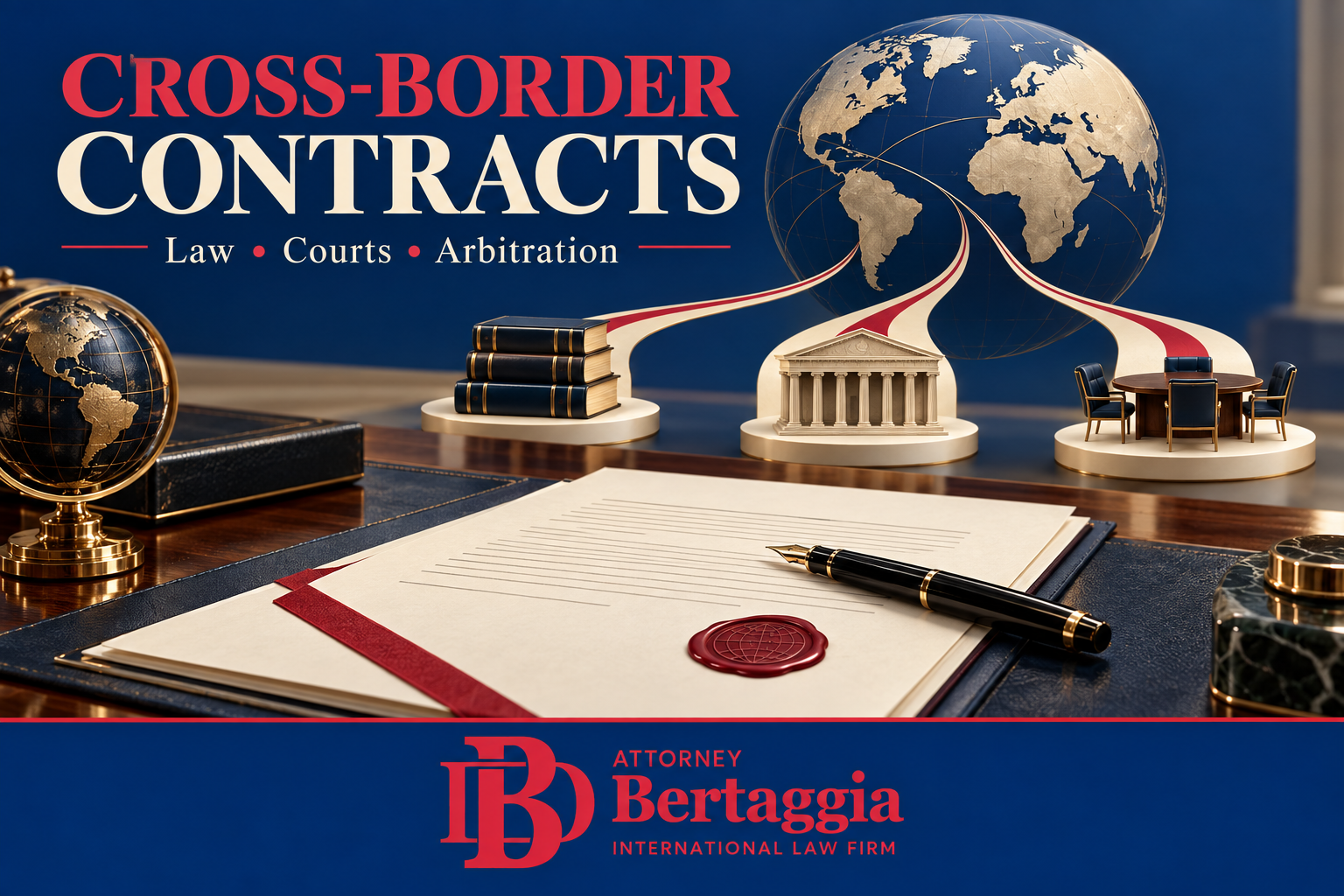
Cross-border contracts should answer three separate questions: which law governs the agreement, who decides a dispute, and where the result can be enforced. International investors often negotiate price, ownership and delivery carefully, then accept a dispute clause copied from another transaction. That shortcut can create expensive uncertainty when a payment, exit or performance obligation is contested.
Legal framework checked on 27 September 2026. This guide concerns business-to-business agreements and does not replace advice on the specific countries, parties and transaction.
Cross-border contracts: start with the commercial risk
Before choosing a court or arbitration, identify the contracting entity, the people authorised to sign and the assets available if the other party defaults. A familiar group name is not a substitute for the legal identity of the company that owes the obligation.
Our practical starting point is a short transaction map: who pays, who performs, where performance takes place and which documents control the relationship. Include purchase orders, guarantees and any shareholders’ agreement. Contradictory clauses across those documents can undermine a carefully drafted main contract.
Governing law is not the same as jurisdiction
Within its scope, the Rome I Regulation allows parties to choose the law governing contractual obligations. Article 3 requires an express choice or one clearly demonstrated by the terms or circumstances. Article 2 allows the designated law to be that of a non-Member State. However, choice of law does not remove all mandatory protections: Article 9 addresses overriding mandatory provisions. Rome I also excludes arbitration and choice-of-court agreements themselves, alongside specified company-law matters, from its scope. See Rome I, Articles 1–3 and 9.
The drafting lesson is to address applicable law and dispute resolution separately. A clause selecting Italian law does not, by that wording alone, identify an Italian court as the agreed forum. Similarly, selecting a foreign forum does not complete the substantive-law analysis.
Choosing a court: check the applicable framework
For agreements choosing courts of an EU Member State, Article 25 of Brussels I bis provides an important framework, including requirements for consent and form. The agreed jurisdiction is generally exclusive unless the parties agree otherwise. But Article 25 does not override the Regulation’s protected-party rules or Article 24 exclusive jurisdictions. Do not assume every corporate dispute can be allocated freely by contract. See Regulation 1215/2012, Articles 24–25.
For the proposed forum, ask counsel to check the clause’s scope, formal validity, any mandatory jurisdiction and the likely proceedings. Specify the court or courts accurately. Avoid vague references to “international courts” or inconsistent alternatives scattered through standard terms.
Will a foreign judgment be recognised?
The 2005 Hague Choice of Court Convention addresses qualifying exclusive court agreements in international civil or commercial cases. Its framework supports the chosen court and recognition of resulting judgments, subject to its conditions and exceptions. Important exclusions include insolvency and certain questions about the validity, dissolution or organs of legal persons. Interim protective measures are outside its regime. These limits matter when a contractual payment dispute develops into a corporate or insolvency dispute. See the Convention, Articles 1–2, 7–9 and 16.
Check entry-into-force dates, territorial coverage and declarations using the HCCH status table. A signature alone does not establish that the Convention applies. Depending on the countries and dispute, other treaties, EU rules or domestic recognition law may govern instead. Selecting a court is therefore only part of the enforcement analysis.
Arbitration: design the process, not just the label
The New York Convention provides an international framework for recognition of arbitration agreements and enforcement of foreign or non-domestic awards. Its existence does not guarantee recovery. Treaty applicability, reservations and the conditions for recognition must still be checked in the relevant jurisdictions. Consult UNCITRAL’s official Convention materials and the status information.
A tailored arbitration clause should address the institution and rules, legal seat, language, number of arbitrators and scope of disputes. The seat deserves particular attention because the procedural legal framework must be assessed separately from any hearing location. Ask which courts may assist or supervise the process and how urgent relief would be obtained.
Arbitration should not be sold as automatically cheaper, faster or confidential. Assess expected claim values, institutional and tribunal costs, the need for specialist decision-makers, and any confidentiality arrangements actually available. A modest unpaid invoice and a complex acquisition dispute may justify different solutions.
Test the clause against a realistic failure scenario
Consider a hypothetical foreign subsidiary buying equipment from a supplier whose substantial assets are elsewhere. The contract provides a payment schedule and warranty but leaves the dispute clause unclear. If the equipment fails, the buyer may face arguments over the forum before reaching the technical dispute.
Before signature, test both perspectives: what would happen if the buyer stopped paying, and what would happen if the supplier failed to perform? Identify the evidence, notices, limitation issues, urgent measures and likely enforcement location. This is a planning exercise, not a prediction that litigation will occur or succeed.
A practical review checklist for cross-border contracts
- Parties: exact legal names, authority and the role of any guarantor.
- Documents: consistent clauses across the main agreement, annexes and standard terms.
- Law and forum: separate, precise choices checked against mandatory rules.
- Procedure: workable notice, escalation and dispute provisions without obstructing urgent protection.
- Enforcement: asset location, applicable recognition route and realistic recovery costs.
For related preparation, see our overseas business-partner guide and Italian company acquisition due-diligence guide.
How Studio Bertaggia can assist international investors
Led by Avv. Daniele Bertaggia, Studio Bertaggia can review the contract as part of the investment structure. The work can include identifying inconsistencies, negotiating the allocation of risk and comparing dispute routes against the countries and assets involved. Where foreign-law input is needed, the engagement should define the required local professional support.
The practical value is a coherent plan connecting the commercial bargain with a usable legal remedy. A polished clause is insufficient if it names the wrong party, conflicts with another document or ignores where enforcement would occur. Our international corporate services and English-speaking legal assistance in Italy provide a starting point for discussing your requirements.
Send the proposed agreement, the countries involved and a brief explanation of the transaction to arrange a scoped consultation. Justyna Pisyak coordinates appointments. The assessment will identify the work and professional support needed; no litigation result or recovery is guaranteed.