
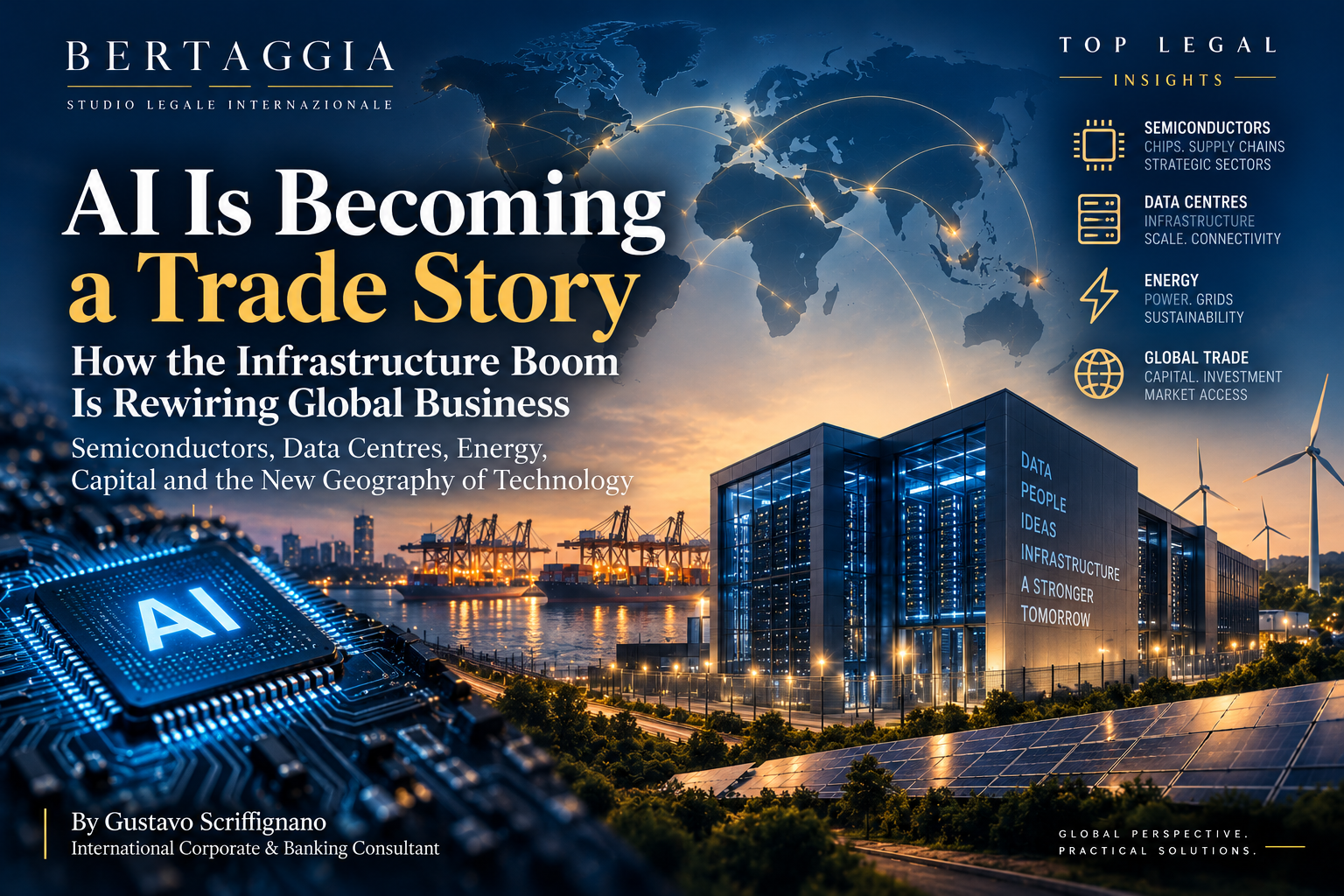
Semiconductors, Data Centres, Energy, Capital and the New Geography of Technology
By Gustavo Scriffignano
International Corporate & Banking Consultant
International Corporate & Banking Consultant
Studio Legale Internazionale Bertaggia
International Business & Technology · Sources checked on 9 October 2026
Artificial intelligence is usually discussed as software.
For international business, that is becoming only half the story.
The current AI investment cycle is increasingly visible in the physical economy: semiconductors, servers, data centres, electricity generation, grid connections, cooling equipment, fibre, industrial real estate, specialist construction and long-term financing.
That shift is now large enough to affect world trade.
The World Trade Organization reported on 8 October 2026 that AI-enabling goods — including semiconductors and servers — accounted for 47% of the growth in the value of global merchandise trade during the first half of 2026. Trade in these goods rose 67% year-on-year, and their share of world merchandise trade reached 14.8%.
The important point is not simply that AI is growing quickly.
It is that AI is becoming an infrastructure story, a trade story and a capital-allocation story at the same time.
TOP LEGAL — THE CORE IDEA
The AI economy may look digital on the screen, but underneath it is remarkably physical: factories, chips, electricity, cables, land, capital and international supply chains.
1. AI is already changing the composition of world trade
The WTO’s latest trade outlook shows how concentrated the current boom has become.
AI-enabling goods accounted for almost half of year-on-year growth in the value of world merchandise trade in the first half of 2026. The category includes semiconductors, servers and other equipment used to build computing infrastructure.
Trade in these goods grew by 67% year-on-year in the first half of 2026, after already rising strongly in 2024 and 2025.
The WTO also notes that this trade is geographically concentrated. In 2025, the top ten traders accounted for around 85% of exports and 80% of imports of AI-enabling goods.
That concentration has two business consequences.
First, companies exposed to AI supply chains are operating in markets with unusually strong demand.
Second, the same companies are exposed to a relatively small number of production centres, technology suppliers and logistics routes.
Growth and concentration are therefore increasing at the same time.
2. The AI stack is much more physical than it appears
A useful way to understand the current investment cycle is to separate the AI stack into layers.
| Layer | Physical requirement | International-business question |
|---|---|---|
| Advanced semiconductors | Fabrication, packaging, equipment and materials | Where are the critical components made and who can legally supply them? |
| Servers and accelerators | Manufacturing, assembly and logistics | How quickly can capacity be delivered and replaced? |
| Data centres | Land, buildings, racks, cooling and security | Where can large facilities actually be built and operated? |
| Electricity | Generation, transmission and grid connection | Is sufficient reliable power available at an acceptable cost? |
| Connectivity | Fibre, subsea cables and network interconnection | Can data move at the required latency and scale? |
| Capital | Equity, debt, leases and project finance | Who is funding the very high upfront cost? |
| Regulation | Planning, energy, data, export controls and investment rules | What approvals constrain the project? |
The software layer may change quickly.
The physical layer does not.
A data centre can be designed in months, but power infrastructure, grid reinforcement and semiconductor capacity can require much longer lead times.
This mismatch creates bottlenecks — and bottlenecks create commercial opportunities.
3. Semiconductors are becoming one of the most strategic trade categories
The AI boom depends on advanced chips, memory, networking equipment and specialised manufacturing tools.
That makes the semiconductor supply chain strategically important far beyond the technology sector.
A modern chip may involve:
- design in one jurisdiction;
- fabrication in another;
- specialist equipment from several countries;
- advanced packaging elsewhere;
- final integration into servers in another production centre;
- deployment in a data centre thousands of kilometres away.
No single country controls the whole chain.
That is why semiconductors sit at the intersection of trade policy, industrial policy and economic security.
For international companies, the practical questions include:
- who supplies the critical component;
- how concentrated that supplier base is;
- whether export controls apply;
- whether the relevant technology can be transferred;
- how long replacement capacity would take;
- whether customers require a specific origin or security standard.
A business can have strong demand and still be constrained by one upstream component.
4. Data centres are becoming industrial assets
Data centres are often discussed as part of the digital economy.
Operationally, they increasingly resemble major infrastructure projects.
They require:
- suitable land;
- substantial electricity capacity;
- high-quality fibre connectivity;
- cooling systems;
- backup power;
- water or alternative cooling solutions, depending on design;
- specialist construction;
- physical security;
- planning and environmental approvals.
The IEA projects global electricity consumption by data centres to rise from about 485 TWh in 2025 to around 950 TWh in 2030 in its central outlook.
AI-focused data centres are expected to grow much faster than the overall data-centre market.
That makes site selection a much more complex exercise than choosing a low-tax jurisdiction.
The company may need to compare:
- power availability;
- grid-connection timing;
- electricity pricing;
- renewable or firm-power options;
- land and construction cost;
- network connectivity;
- permitting;
- data regulation;
- climate and cooling efficiency;
- access to financing.
A cheap site without power is not a cheap site.
5. Electricity is becoming part of technology strategy
One of the most important consequences of the AI boom is the renewed strategic importance of electricity.
The IEA’s 2026 outlook says data-centre expansion is a major contributor to electricity-demand growth in advanced economies. In the United States, data centres are expected to account for about half of electricity-demand growth through 2030.
This changes the commercial map of technology investment.
A jurisdiction with strong digital demand but constrained grid capacity may struggle to add computing infrastructure quickly.
A region with abundant power but poor connectivity may face the opposite problem.
The strongest locations increasingly combine:
- scalable electricity supply;
- high-quality grids;
- strong network infrastructure;
- suitable land;
- predictable permitting;
- financing;
- political support for large infrastructure.
Energy policy and technology policy are therefore converging.
6. AI infrastructure is creating a financing problem as well as a technology opportunity
AI infrastructure is capital intensive.
Large-scale computing facilities require enormous upfront expenditure before they generate meaningful revenue.
The financing can involve:
- corporate balance sheets;
- project finance;
- bank debt;
- infrastructure funds;
- equipment leasing;
- sale-and-leaseback structures;
- sovereign or development-bank support;
- public-private programmes.
That creates a distinction between a company that builds AI software and a company that builds AI infrastructure.
The second business may depend less on software margins and more on:
- utilisation;
- power cost;
- debt cost;
- equipment depreciation;
- customer concentration;
- long-term capacity contracts.
For investors, AI infrastructure should therefore be analysed partly like technology and partly like infrastructure.
7. The geography of AI is becoming more concentrated — and more contested
The WTO’s data on AI-enabling goods shows high geographic concentration.
UNCTAD’s 2026 Trade and Development Report adds another dimension: export controls, investment screening and supply-chain conditions are making strategic sectors harder for new entrants to access.
This means the AI boom is global, but not evenly global.
Some regions control critical manufacturing.
Others have abundant capital.
Others have power and land.
Others have strong consumer demand or research ecosystems.
The challenge for international companies is to understand which part of the AI value chain they are actually participating in.
A company does not need to dominate the entire stack.
It needs to know which dependency it owns and which dependencies it rents from others.
8. Europe is treating computing capacity as strategic infrastructure
Europe offers a useful example of how AI is becoming an infrastructure-policy issue.
The European Commission now operates a network of AI Factories linked to EuroHPC supercomputing infrastructure.
It has also launched a call for up to seven AI Gigafactories — large-scale facilities combining advanced processors, cloud technology, high-speed connectivity and energy-efficient data centres.
The initiative is supported by up to EUR 10 billion in EU and national funding and is intended to unlock at least EUR 20 billion in private investment.
The policy rationale is clear: computing capacity is increasingly being treated as strategic infrastructure.
The EU’s proposed Cloud and AI Development Act follows the same logic by seeking to create conditions for expanding cloud and data-centre capacity.
For businesses, this means government policy can affect not only regulation but also the availability and economics of infrastructure itself.
9. The real opportunity may be outside the model layer
Much attention goes to companies developing frontier models.
That is understandable.
But the infrastructure cycle can create opportunities in sectors that are less visible.
| Area | Potential commercial opportunity |
|---|---|
| Power generation | Long-term electricity supply for data centres |
| Grid equipment | Transformers, switchgear and connection infrastructure |
| Cooling | Liquid cooling, chillers and thermal management |
| Construction | Specialist data-centre design and engineering |
| Fibre | Network build-out and interconnection |
| Real estate | Powered land and data-centre campuses |
| Cyber-security | Protection of critical computing infrastructure |
| Finance | Debt, leasing, structured finance and infrastructure capital |
| Professional services | Regulation, contracts, site selection and cross-border structuring |
The winners of the AI investment cycle may therefore include companies that never train an AI model.
They may build what AI requires.
10. Location decisions need a new scorecard
Traditional international-expansion analysis often focused on tax, labour and customers.
AI infrastructure requires a different scorecard.
| Decision factor | Key question |
|---|---|
| Power | Is sufficient capacity available and how long is the grid connection? |
| Chips | Can critical hardware be sourced legally and reliably? |
| Connectivity | Is the site connected to major network routes? |
| Capital | Can the project obtain long-duration financing? |
| Permitting | How long will approvals take? |
| Cooling | Is the climate and infrastructure suitable? |
| Security | Are physical, cyber and supply-chain risks manageable? |
| Policy | Are subsidies, export controls or investment screening relevant? |
| Customers | Is there enough real compute demand to justify the capacity? |
A jurisdiction that scores well on one variable may perform poorly on another.
That is why AI infrastructure is unlikely to concentrate solely in the country offering the largest tax incentive.
11. Supply-chain resilience matters because replacement times are long
One of the distinctive risks in AI infrastructure is replacement time.
If a software provider fails, another service can sometimes be deployed relatively quickly.
Replacing advanced semiconductor capacity, large transformers or a grid connection can take much longer.
This changes resilience planning.
Management should map:
- single-source semiconductor dependencies;
- equipment lead times;
- grid-connection risk;
- backup power;
- network redundancy;
- construction bottlenecks;
- critical suppliers;
- financing dependencies.
The more capital intensive the project, the more expensive an interruption becomes.
12. AI infrastructure is also an economic-security issue
Governments increasingly view advanced computing as a strategic capability.
That means companies operating in the AI infrastructure stack may encounter:
- export controls;
- investment screening;
- technology-transfer restrictions;
- government procurement conditions;
- data localisation;
- cyber-security requirements;
- restrictions affecting critical infrastructure.
This creates a familiar tension.
The technology is global.
The rules governing it are increasingly national or regional.
International businesses therefore need to design structures around both commercial efficiency and regulatory access.
13. A practical example: choosing a data-centre location
Consider a hypothetical European infrastructure investor evaluating three locations for a large AI-oriented data centre.
Location A — strong digital market, constrained grid
Advantages:
- customers nearby;
- strong fibre connectivity;
- mature data-centre ecosystem.
Disadvantages:
- slow grid connection;
- high electricity cost;
- limited available land.
Location B — abundant power, weaker customer proximity
Advantages:
- lower power cost;
- land availability;
- supportive authorities.
Disadvantages:
- weaker network density;
- longer route to major customers;
- less developed specialist workforce.
Location C — strong incentives and infrastructure programme
Advantages:
- public support;
- accelerated permitting;
- strategic-infrastructure status.
Disadvantages:
- policy conditions;
- clawback obligations;
- greater dependence on government programmes.
The best location cannot be identified from one metric.
The project needs a combined commercial, power, financing, regulatory and infrastructure model.
14. What international companies should review before committing capital
Before committing to an AI-infrastructure project, management should be able to answer the following questions.
- What part of the AI value chain are we actually entering?
- Which components are genuinely scarce?
- Where are those components produced?
- What is the lead time for replacement?
- How much power is required now and after expansion?
- Is the grid connection confirmed or merely expected?
- What currencies and financing sources fund the project?
- Are export controls or investment screening relevant?
- Is customer demand contracted or speculative?
- Does the project remain viable if hardware prices, power costs or financing conditions change?
A credible AI-infrastructure investment should survive a less optimistic scenario.
Frequently asked questions
Is AI really becoming a major driver of global trade?
Yes. WTO data for the first half of 2026 shows AI-enabling goods accounting for 47% of year-on-year growth in the value of global merchandise trade, with trade in those goods rising 67%.
Are data centres becoming one of the main sources of electricity demand growth?
In some markets, yes. The IEA projects global data-centre electricity use to roughly double by 2030, with particularly large effects in the United States, China and some Asian markets. Globally, data centres remain a minority share of electricity consumption, but their demand is highly concentrated geographically.
Does every company exposed to AI need to own data-centre infrastructure?
No. Many companies will access computing capacity through cloud or infrastructure providers. The relevant question is which parts of the value chain should be owned, contracted or diversified.
Are government incentives enough to make a data-centre location attractive?
No. Power availability, connectivity, land, permitting, financing and customer demand usually matter more over the life of the project. Incentives can improve a strong location but may not compensate for structural constraints.
Could AI infrastructure become overbuilt?
Yes. Rapid investment can create excess capacity if demand grows more slowly than expected or if hardware efficiency improves faster than projected. Projects should therefore be tested against more conservative utilisation and pricing scenarios.
Conclusion: AI is digital at the surface and industrial underneath
The current AI cycle is changing the physical economy.
It is driving demand for semiconductors, servers, electricity, data centres, network infrastructure and capital.
That is why AI is increasingly relevant to companies far beyond the software sector.
For international business, the central question is no longer simply which model will win.
It is also:
Who will build, finance, power and connect the infrastructure that every model requires?
The AI economy may be digital at the surface.
Underneath, it is industrial.
And the companies that understand that distinction may find opportunities in places that have little to do with writing software.
The winners of the AI investment cycle may not only be the companies building intelligence.
They may also be the companies building everything intelligence requires.
Discuss an international technology or infrastructure project
Studio Legale Internazionale Bertaggia assists clients with cross-border corporate structures, international investment planning, governance and coordination with local advisers.
Avv. Daniele Bertaggia leads the legal assessment, supported by Gustavo Scriffignano on international corporate and banking matters.
A preliminary review should normally identify the proposed activity, jurisdiction, ownership, financing, expected customers, power and infrastructure requirements, strategic-sector exposure, technology dependencies and any relevant investment incentives or screening rules.
International company formation · English Insights · Contact the Studio
Related reading
The Return of Industrial Policy · The New Map of Global Business · The End of the Single-Bank Strategy · Hong Kong or Singapore?
About the author
Gustavo Scriffignano
Junior Partner | International Corporate & Banking Consultant
Gustavo provides international corporate and banking support under the leadership of Avv. Daniele Bertaggia.
Editorial notice: General international business, technology and infrastructure analysis, not individual legal, tax, investment, energy, export-control or regulatory advice. Project viability depends on the applicable jurisdiction, financing, technology, infrastructure, power availability, contractual arrangements and regulatory framework.
Sources and further reference
1. WTO — AI boom and trade resilience lift outlook, 8 October 2026: https://www.wto.org/english/news_e/news26_e/stat_08oct26_510_e.htm
2. WTO — Global Trade Outlook and Statistics, Executive Summary: https://www.wto.org/english/res_e/publications_e/global-trade-outlook-and-statistics_execsum_e.htm
3. UNCTAD — Trade and Development Report 2026: The geoeconomics of development: https://unctad.org/publication/trade-and-development-report-2026
4. UNCTAD — Trade and Development Report 2026 press release: https://unctad.org/press-material/unctad-trade-and-development-report-2026-global-growth-slows-26-and-gaps-widen
5. UNCTAD — High-tech goods power global trade amid uncertainty: https://unctad.org/news/high-tech-goods-power-global-trade-amid-uncertainty
6. UNCTAD — AI-driven trade boom masks broader slowdown: https://unctad.org/news/ai-driven-trade-boom-masks-broader-slowdown
7. IEA — Key Questions on Energy and AI: https://www.iea.org/reports/key-questions-on-energy-and-ai
8. IEA — Energy and AI, Executive Summary: https://www.iea.org/reports/energy-and-ai/executive-summary
9. IEA — Electricity 2026, Demand: https://www.iea.org/reports/electricity-2026/demand
10. European Commission — AI Factories: https://digital-strategy.ec.europa.eu/en/policies/ai-factories
11. European Commission — Cloud and AI Development Act proposal: https://digital-strategy.ec.europa.eu/en/library/proposal-cloud-and-ai-development-act-cada
12. European Commission — EU launches AI Gigafactories call: https://digital-strategy.ec.europa.eu/en/news/eu-launches-ai-gigafactories-call-boost-europes-computing-capacity-and-unlock-more-eu30-billion