
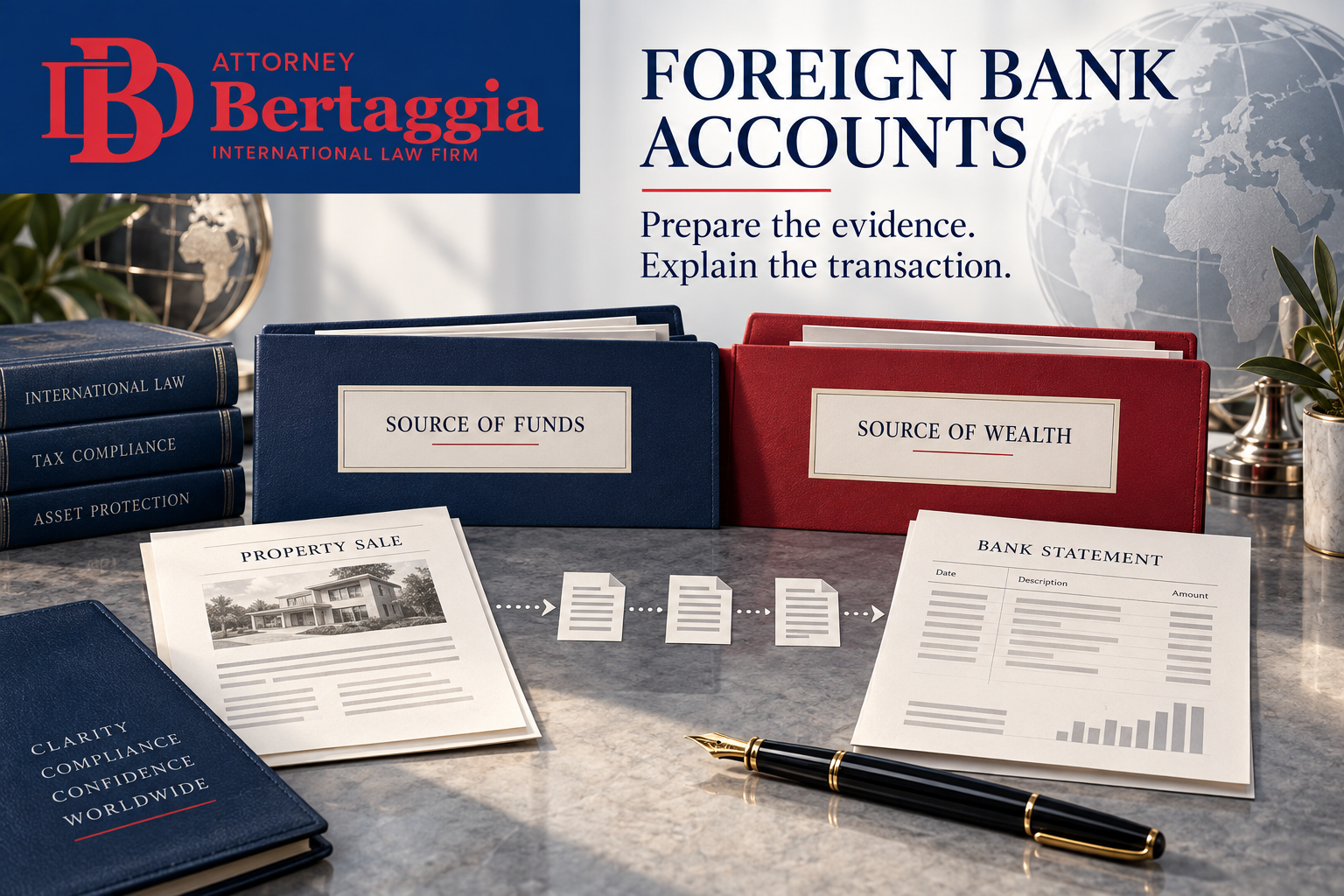
Source of funds for a foreign bank account is more than the name of the bank sending the transfer. International investors need a clear account of where the money came from, who owns it and why it is moving. Preparing that evidence before applying can make the discussion with a bank more focused.
This guide explains how individuals and companies can organise a banking file. It separates regulatory principles from practical preparation: the receiving institution determines the documents it needs under the law and its own acceptance policy.
Editorial review: 23 September 2026. UK regulatory guidance is identified as a jurisdiction-specific example, not a universal banking rule.
1. Source of funds and source of wealth: two different questions
Source of funds concerns the origin of the money involved in a particular relationship or transaction. Source of wealth concerns how the customer’s overall wealth was accumulated. A property sale might explain a deposit, while a career or business history helps explain how the property was acquired.
FCA supervisory material illustrates the use of customer information together with supporting records, including ownership documents, accounts, salary evidence and bank statements. These are examples of evidence, not a mandatory worldwide checklist. FCA: source-of-wealth and funding checks.
For your own preparation, write two separate summaries. One should explain the proposed opening transfer. The other should describe the relevant background to your assets. Reconcile dates, amounts and ownership between them. If the histories differ, explain the difference instead of forcing them into one sentence.
2. Why banks ask about the source of funds
FATF Recommendations set international standards for anti-money-laundering measures, including customer due diligence. They are implemented through national frameworks; they are not a single account-opening statute applicable identically everywhere. FATF Recommendations.
As a UK example, FCA guidance addresses identification of customers and beneficial owners, the purpose of the relationship, ownership structures and ongoing monitoring. It also distinguishes enhanced checks for increased risks. A bank unable to complete required due diligence cannot simply overlook the gap because an adviser introduced the customer. FCA Financial Crime Guide, sections 3.2.4–3.2.9.
Ask the institution to explain its documentation requirements for your actual profile. Its acceptance policy, supported countries, business sectors and available services need separate discussion. Meeting a document request does not itself establish a right to a particular commercial account.
3. Build a transaction file, not an unstructured pile of documents
The following is a practical preparation method. It is not a statement that every bank requires every item:
- Employment savings: organise income evidence and the account history that connects earnings to the amount proposed for transfer.
- Sale of property or a business: assemble the agreement, evidence of ownership and completion, and records showing receipt of proceeds.
- Dividends: connect the distribution documentation, relevant company records and the payment received by the shareholder.
- Inheritance or gifts: identify the transferor, the legal basis of receipt and the records linking the assets to the beneficiary.
- Loans or capital contributions: explain the parties, funding terms, approvals and payment route. A loan should not be described as trading revenue.
Use an index with the document date, issuer, language and point it supports. Ask which translations or certifications the bank will accept before commissioning them. Retain originals and complete statements; do not remove context merely to make a file look simpler.
4. Example: property-sale proceeds for a foreign bank account
Consider an illustrative investor who sells a property for EUR 600,000 and expects to transfer EUR 420,000 abroad. The difference may reflect repayment of secured borrowing, transaction expenses or funds retained elsewhere. None of those explanations should be assumed without records.
A useful reconciliation starts with the completion statement and follows the net payment into the seller’s account. It then connects that receipt to the intended transfer. The file should explain material deductions and any intermediate accounts. These figures illustrate document preparation only; they make no assumption about tax due or tax-free proceeds.
If several receipts are mixed in the same account, identify them separately. An account statement establishes movements, but may not establish the underlying reason for every payment. Ask the bank what further evidence it needs.
5. Companies: separate ownership, authority and funding
For a corporate account, prepare a dated ownership chart alongside the account mandate. The person authorised to sign is not necessarily the person who ultimately owns or controls the customer. FCA guidance specifically addresses understanding ownership and control structures for corporate and similar customers. FCA customer due diligence guidance.
Next, describe the proposed first payment. Is it subscribed capital, a shareholder loan, proceeds from customers or a transfer between the company’s own accounts? Explain the real relationship between sender and recipient. Where several group companies are involved, avoid using a group brand as a substitute for the names of the contracting entities.
Prepare a realistic account-use summary: principal markets, counterparties, currencies and expected payment patterns. Label forecasts as forecasts. A newly formed entity should not present projected contracts or revenue as established trading history.
6. Tax residence is a separate part of the banking file
Banking due diligence does not resolve a customer’s tax position. The OECD explains that tax residence is determined under domestic laws and that CRS self-certifications require disclosure of all tax residences. Citizenship or permission to reside somewhere does not automatically settle that question. OECD tax-residence guidance.
Check the relevant jurisdiction’s implementation, reporting rules and any change-of-circumstances obligations. Separately obtain advice on declaring foreign accounts, income and assets in the countries concerned. Neither a bank’s acceptance nor a source-of-funds review is a tax clearance.
7. What to do when evidence is incomplete
Make a gap list before submitting an application. Distinguish documents that can be recovered from records that never existed. Ask the original issuer or relevant professional about legitimate replacements, and explain unresolved gaps accurately.
Do not invent a contract, backdate a declaration or describe an unexplained third-party transfer as your own savings. Where the legal basis of a payment is uncertain, pause and obtain advice. Changing banks does not repair the underlying evidence.
Also plan for later enquiries. UK FCA guidance describes ongoing monitoring and keeping due-diligence information current. An opening file is therefore not a permanent exemption from questions about subsequent activity. FCA ongoing monitoring guidance.
8. How Studio Bertaggia can assist
Studio Legale Internazionale Bertaggia can help structure the preliminary assessment, organise the ownership and funding narrative, identify missing documents and coordinate questions requiring local legal or tax input. The scope of work is agreed for the particular client and jurisdictions.
Gustavo Scriffignano supports the international banking and operational assessment. Avv. Daniele Bertaggia, founder and managing partner, leads legal coordination. Justyna Pisyak coordinates enquiries and appointments.
The practical value is a coherent, documented proposal: the intended account activity, corporate structure and evidence of funding should tell the same story. The Studio cannot guarantee approval, confidentiality against lawful disclosure, a fixed opening time or acceptance of a particular transaction.
Read more about our foreign bank account advisory, international company formation and international taxation services. For jurisdiction-specific context, see our Swiss banking guide and Panama banking guide.
Discuss your foreign banking requirements
Start with your country of residence, the proposed account holder, the purpose of the account and a short description of the funding. Agree a suitable document-delivery method before sending sensitive records.
General information, not an individual legal or tax opinion. Illustrations and preparation suggestions are not bank acceptance criteria. Applicable laws, bank policies and the circumstances of each transaction require individual assessment.
Official sources
Consulted on 23 September 2026.