
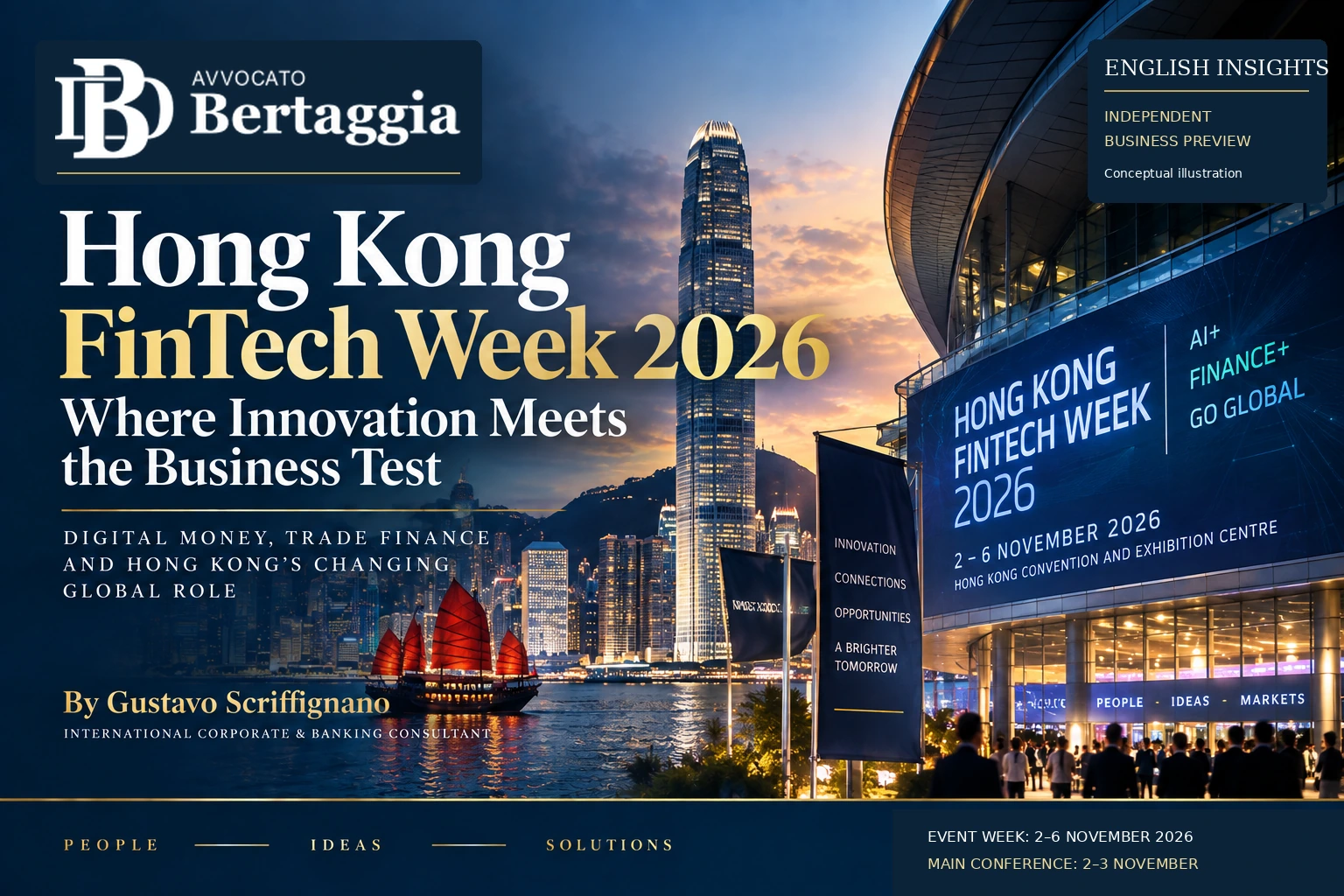
Digital Money, Trade Finance and Hong Kong’s Changing Global Role
The most useful question at a fintech conference is not simply “What is new?” It is “What will make a real difference once the event is over?”
A payment that is easier to reconcile. A better-informed financing discussion. A partner who understands both the technology and the market. Those are worthwhile outcomes—even when they are less dramatic than the headline announcement.
That is the perspective behind this preview of Hong Kong FinTech Week x StartmeupHK 2026, scheduled for 2–6 November, with the main conference on 2–3 November at the Hong Kong Convention and Exhibition Centre. [1]
For international businesses, the opportunity is to connect the financial-technology conversation with decisions about customers, capital, operations and expansion. The objective should be to leave with greater clarity, not merely a longer contact list.
TOP LEGAL — START WITH THE BUSINESS QUESTION
Before judging a solution, define the problem. Then establish who provides the service, what permissions apply, what implementation requires and how success will be measured.
1. Hong Kong FinTech Week 2026: the essentials
The published programme combines finance, technology and entrepreneurship around AI+, Finance+ and Go Global. Its forum overview includes policy, digital assets, artificial intelligence, insurance, sustainability, startups and China–global innovation. These are programme themes, not evidence that every product presented is ready for commercial use. [2][4]
| Item | Confirmed or published information |
|---|---|
| Event | Hong Kong FinTech Week x StartmeupHK 2026. |
| Event week | 2–6 November 2026. |
| Main conference and exhibition | 2–3 November, Hong Kong Convention and Exhibition Centre. |
| Wider activities | Community and networking events at additional venues, including Greater Bay Area connections. |
| Before making arrangements | Check the latest agenda, eligibility, pass inclusions and any separate activity requirements. |
These details follow InvestHK and the organiser’s published information. The wider week should not be confused with five days of main-conference sessions at the convention centre. Programme details can change. [1][3]
A useful preparation exercise is to identify one operational problem, one market question and the counterparties best placed to address them. A focused conversation about a real requirement can be more valuable than attending several unrelated presentations.
2. Why this is more than a technology showcase
At the 2025 edition, the Hong Kong Monetary Authority introduced Fintech 2030, covering data and payment infrastructure, artificial intelligence, resilience and tokenisation. Its announcement set out more than forty initiatives. Those are existing policy commitments to assess—not announcements that this article attributes to the forthcoming 2026 event. [5]
This makes November a useful checkpoint. What has moved from a proposal to a pilot? What has reached real transactions? What is available to the intended customer today, rather than only to selected participants?
International connections are also taking institutional form. Euroclear joined the HKMA’s Project Ensemble in April 2025, contributing to work on tokenisation and interoperability. That is a specific European connection to Hong Kong’s financial infrastructure—not a claim that every European business can access the resulting arrangements. [6]
3. Digital money: understand the claim behind the technology
“Digital money” is not one product. A bank deposit, a stablecoin and a tokenised investment can involve different counterparties, rights and operating conditions. The useful assessment starts with what the holder is entitled to—not the appearance of the interface.
The HKMA announced EnsembleTX in November 2025 as a controlled pilot enabling real-value transactions in tokenised deposits and digital assets. Its announced programme runs through 2026, initially using Hong Kong’s existing real-time gross settlement infrastructure for interbank settlement. Planned development towards around-the-clock settlement should not be confused with universal availability. [7]
Separately, on 10 April 2026, the HKMA announced stablecoin issuer licences for Anchorpoint Financial Limited and The Hongkong and Shanghai Banking Corporation Limited. That dated decision establishes the licences granted then; it does not establish that every proposed product is now available to every business. [8]
Use the following as a discussion worksheet, not a classification or recommendation of a particular investment.
| Product or proposal | What needs to be understood | Practical question |
|---|---|---|
| Tokenised deposit | The bank obligation, account terms, transfer conditions and applicable protections. | Can the intended company access it and reconcile it with its records? |
| Stablecoin | The issuer, reserves, redemption rights, permitted distribution and relevant permissions. | How are usable funds recovered, and what happens if access is interrupted? |
| Tokenised investment | The underlying rights, custody, valuation and transfer restrictions. | What does the holder own, and how can those rights be exercised? |
| Pilot or sandbox | The participants, limits, duration and conditions for wider use. | Is this a testing opportunity or a service ready for ordinary operations? |
The message is not to dismiss innovation. It is to distinguish a promising design from an arrangement that fits the business’s actual requirements. This article does not recommend acquiring digital assets.
4. Trade finance: less spectacle, potentially more usefulness
For an exporter, the most valuable innovation may be a better way to explain its trading activity to a lender.
The HKMA’s Commercial Data Interchange supports consent-based sharing between participating banks and commercial-data providers. Its published uses include credit assessment and customer verification. The platform also records the launch of the CargoX Pilot Programme on 7 May 2026, adding a concrete development to the discussion about cargo data and trade finance. Neither initiative guarantees credit to an individual applicant. [9]
A company can turn that discussion into a practical enquiry: are its invoices, shipment records and receipts suitable for the proposed process? Who supplies the information? Who can correct mistakes? What independent assessment does the bank still require?
The potential value lies in reducing repetitive work and making the financial picture clearer. It does not require pretending that a new platform can repair inaccurate records or remove a lender’s judgement.
Start by tracing one transaction through the existing process. Where does information become delayed, duplicated or inconsistent? That gives a provider something concrete to demonstrate—and gives the business a basis for measuring improvement.
5. Faster payments: follow the money all the way through
A payment is not finished merely because the sender’s screen shows a successful instruction. Assess the route through to the recipient’s usable funds and the corresponding accounting record.
Payment Connect links Hong Kong’s Faster Payment System with mainland China’s Internet Banking Payment System. The clearing operator describes defined remittance categories, limits and institution-specific services, including selected business-to-personal uses. It is not a universal facility for every corporate invoice or a removal of foreign-exchange requirements. [10]
For any proposed service, ask for the actual currencies, institutions, operating hours, eligibility and handling of exceptions. A demonstration between two participating accounts may not describe the route your own customers use.
Compare conversion, implementation and reconciliation costs alongside the advertised fee. Then ask what happens when information is wrong or a payment needs investigation. The answer can matter more than a few seconds saved in the ideal case.
The benchmark should be a completed, traceable business transaction—not a particularly impressive demonstration.
6. AI in finance: efficiency needs an accountable process
The programme includes an AI in Finance Forum. That creates room for a useful discussion about where automation improves financial work and where consequential decisions still require oversight. [4]
Begin by defining the task. Sorting documents, identifying an unusual transaction and making a decision about a customer are not identical uses. Ask which parts of the process the supplier controls and which remain the business’s responsibility.
Hong Kong’s Privacy Commissioner published an Artificial Intelligence: Model Personal Data Protection Framework in June 2024. It addresses governance, risk assessment, oversight and communication when organisations procure or use AI involving personal data. It is guidance, not a vendor-approval certificate. [11]
Request an example with incomplete or conflicting information. Who checks the result? Can the business explain it? How is an error corrected? A credible provider should be able to discuss limitations as clearly as advantages.
Contractual preparation should cover information access, permitted reuse, security incidents, support and the ability to retrieve records. Faster processing is useful only if the business retains an appropriate level of understanding and control.
7. Hong Kong’s international role: opportunity with clear boundaries
InvestHK presents the event as a meeting point between mainland Chinese innovation and international markets. For a European business, the useful question is which connections could support its specific customers, partnerships or regional operations. [1]
The opportunity is to investigate commercial fit—not assume that the relevant markets share one regulatory system.
For example, a Hong Kong permission is not an automatic EU authorisation. Article 59 of the EU Markets in Crypto-Assets Regulation identifies the authorisation basis for crypto-asset services in the Union, including the specified route for certain financial institutions. It does not turn a non-EU licence into an EU passport. Other services require their own analysis. [12]
Personal-data transfers need a separate review. The European Commission identifies mechanisms including adequacy decisions, standard contractual clauses and binding corporate rules. The appropriate mechanism and any additional assessment depend on the actual transfer; using the same software in two countries does not settle the question. [13]
A good international partner should make those differences easier to understand. The ability to identify where local expertise is needed is a strength, not a weakness in a “global” proposition.
The China–Hong Kong–Europe business outlook explores the wider geopolitical context. The conference discussion should bring that context back to an identifiable business decision.
8. Founders: leave with a next step, not just positive feedback
The Global Fast Track 2026 programme describes business matching, investor and corporate connections, market readiness and pitching opportunities. Those can support a company’s preparation, but participation is not a commitment to finance it or purchase its product. [14]
Its published timeline gives 25 September 2026 as the pitching-competition application deadline. That date has passed as of this article’s 30 September review. Check current arrangements directly with the organiser rather than assuming that a different application button reopens the original competition. [14]
Prepare a concise explanation of the problem, target customer, operating product, ownership and support being sought. Distinguish a deployment from a trial and a signed customer from an encouraging discussion.
A financial institution will need to understand integration, controls and responsibility. A potential investor will need a coherent ownership and funding picture. Both should be able to reconcile the presentation with the company’s actual documents.
An effective meeting ends with a named reviewer, an agreed information request and a decision date. “Let’s stay in touch” is a pleasant ending; it is not yet a development plan.
9. A practical example: the exporter that needs better visibility
This scenario is hypothetical. It is not a client case or a forecast of savings.
An Italian exporter uses a Hong Kong purchasing company and serves customers in several markets. Its finance team spends too much time matching invoices, shipments and payments. Financing discussions repeatedly require the same records in different formats.
The company defines three objectives before evaluating providers: better reconciliation, a clearer financing file and more reliable payment visibility. It does not begin by deciding which technology it must purchase.
Each provider is asked to explain the same workflow using synthetic information. The team records the contracting entity, implementation requirements, costs, information access and ongoing support. It avoids sharing customer files or making payments merely to try an unsolicited demonstration.
Where the assessment supports a pilot, the agreement specifies its scope, success measures, responsibilities and exit arrangements. Useful measures might include fewer unmatched items, less re-entry and faster resolution of exceptions.
The result may be a new service, a better use of the existing bank relationship or a decision not to change. Each is a legitimate outcome when it follows a clear assessment. The goal is an improvement the business can demonstrate, not a technology purchase it must later justify.
10. Turn a useful introduction into a sound decision
The following checklist is a preparation tool, not a statutory form or an organiser requirement.
| Review area | What the business should establish |
|---|---|
| Purpose | The actual payment, financing, reporting or customer problem. |
| Counterparty | The legal entity, authority to contract and permissions relevant to its activity. |
| Readiness | Whether the offer is a concept, controlled pilot or available service. |
| Rights and information | Contractual obligations, data access, records and incident responsibilities. |
| Complete cost | Implementation, recurring charges, transactions, conversion and exit. |
| Next decision | The required evidence, responsible reviewer and conditions for proceeding. |
A conference badge is not due diligence. The HKMA’s April stablecoin announcement directs the public to its official register and warns about fraudulent claims of association with licensees. Check the relevant entity and source independently rather than relying on a familiar name or logo. [8]
For the first conversation, share enough to explain the business problem—not unrestricted confidential material. Agree the purpose, channel and protections before exchanging sensitive records.
Frequently asked questions
When and where is Hong Kong FinTech Week 2026?
The event week is scheduled for 2–6 November 2026. The main conference and exhibition are on 2–3 November at the Hong Kong Convention and Exhibition Centre, with additional activities elsewhere. Check the current programme before making arrangements. [3]
Is it relevant to businesses that are not fintech companies?
Does a regulatory pilot make a service available to everyone?
No. A controlled pilot may have defined participants, transactions and limits. EnsembleTX was announced on that basis. Ask whether the intended business is eligible for the particular service under discussion. [7]
Does a licence mean a provider is right for the business?
No. Verify the current permissions and contracting entity, then assess eligibility, terms, costs and operational fit. Do not confuse a genuine licence with a guarantee about a specific product or commercial outcome. [8]
Should a business incorporate in Hong Kong before exploring opportunities?
Not by default. Establish the proposed activity, relationships, management, banking requirements and relevant permissions first. A useful introduction does not, on its own, create a reason to establish another company.
Conclusion: be open to the technology and precise about the purpose
The most interesting fintech conversations connect an ambitious idea with an ordinary business problem—and then explain how the proposed solution would work.
Hong Kong FinTech Week offers a setting in which to investigate those connections. The useful outcome is not simply enthusiasm. It is a better-defined opportunity, a credible counterparty and a decision supported by evidence.
The technology matters. The people and judgement around it matter too. Keep the ambition, ask the practical questions and give the next step enough structure to be meaningful.
The goal is not to return with the most contacts. It is to return with a clearer direction.
Discuss your Hong Kong business and banking project
Studio Legale Internazionale Bertaggia assists with international company structures and corporate coordination. Avv. Daniele Bertaggia leads the legal assessment, supported by Gustavo Scriffignano on international corporate and banking matters. Specialist local, tax or regulatory work should be allocated to appropriately qualified professionals within an agreed engagement. [18][19]
For an initial discussion, outline the entities, markets, intended service and decision under consideration. A preliminary assessment can identify the documents and professional input needed before forming a company, changing banking arrangements or signing a partnership.
Request a cross-border business assessmentInternational company formationForeign banking support
Related reading
Hong Kong business benefits · China, Hong Kong and Europe · Source of funds for a foreign bank account · Starting a business with an overseas partner
English Homepage · English Insights
Editorial notice: Independent pre-event commentary based on sources checked on 30 September 2026. References to third parties do not imply a formal partnership or event endorsement. This article does not announce attendance, speaking or sponsorship by the author or Studio Bertaggia. Programme details may change. It is not individual legal, investment, tax or regulatory advice and does not recommend buying digital assets. Examples and checklists are illustrative. No licence, financing, bank acceptance or commercial outcome is guaranteed.
Sources and further reference
Sources checked on 30 September 2026. Event information and service descriptions may change; dated regulatory announcements retain their original scope.
[1] Invest Hong Kong: Hong Kong FinTech Week x StartmeupHK 2026: official event listing.
[2] Event organiser: Hong Kong FinTech Week x StartmeupHK 2026: programme themes.
[3] Event organiser: 2026 event FAQs: dates, venues and participation.
[4] Event organiser: 2026 forum overview.
[5] Hong Kong Monetary Authority / Hong Kong SAR Government: Fintech 2030 unveiled at Hong Kong FinTech Week 2025, 3 November 2025.
[6] Euroclear: Euroclear joins HKMA’s Project Ensemble, 7 April 2025.
[7] Hong Kong Monetary Authority / Hong Kong SAR Government: EnsembleTX: controlled pilot for real-value transactions, 13 November 2025.
[8] Hong Kong Monetary Authority / Hong Kong SAR Government: Granting of stablecoin issuer licences, 10 April 2026.
[9] Hong Kong Monetary Authority: Commercial Data Interchange: consent-based information sharing and CargoX pilot launch record.
[10] Hong Kong Interbank Clearing Limited: Payment Connect: features and service scope.
[11] Office of the Privacy Commissioner for Personal Data, Hong Kong: Artificial Intelligence: Model Personal Data Protection Framework, 11 June 2024.
[12] European Securities and Markets Authority: MiCA, Article 59: authorisation.
[13] European Commission: Data protection: international dimension and safeguards.
[14] Global Fast Track: 2026 programme, pitching opportunities and application timeline.
[15] FinStep Asia: Official company profile, founder and advisory scope.
[16] FinStep Asia: Go-to-market services: market entry and institutional engagement.
[17] Cranfield University: Syed Musheer Ahmed: Founder and Managing Director of FinStep Asia.
[18] Bertaggia International Law Firm: International company formation: services and professional responsibilities.
[19] Bertaggia International Law Firm: Our Team: Gustavo Scriffignano and legal coordination.